Journey plan
Vienna to Prague with children
Roughly 313 km and about 3h 18m behind the wheel. Once breaks are counted honestly that is nearer 3h 38m door to door — and with a toddler, 3h 38m.
.jpg)
How the timing works
Driver fatigue is the constraint that sets the floor, and it is well studied: time on task degrades reaction time and lane-keeping long before a driver reports feeling tired [1]. A break roughly every two hours is what most national road-safety guidance converges on, and it is the interval this plan uses. On this route that is 1 break.
Children impose a shorter one. Under about four, ninety minutes is a more realistic ceiling before the car becomes unpleasant for everyone in it, which is why the second row of the plan above exists. The difference on this journey is 0 extra stops and about 0h 00m of additional elapsed time.
The number people get wrong is not the driving time — the mapping app gives them that — but the gap between driving time and door-to-door time. Twenty minutes sounds trivial until it is multiplied by the number of stops and added to a departure that was already half an hour late.
What to do with the breaks
A break spent in the car seat is not a break. The point is postural change and, for children, gross motor movement — the thing that makes the next leg tolerable is having actually run around, not having been handed a snack through the window.
Plan the longest break around the meal rather than the other way round. Eating in the car is possible and occasionally necessary, but it removes the one part of the stop that reliably resets everybody.
Car seats
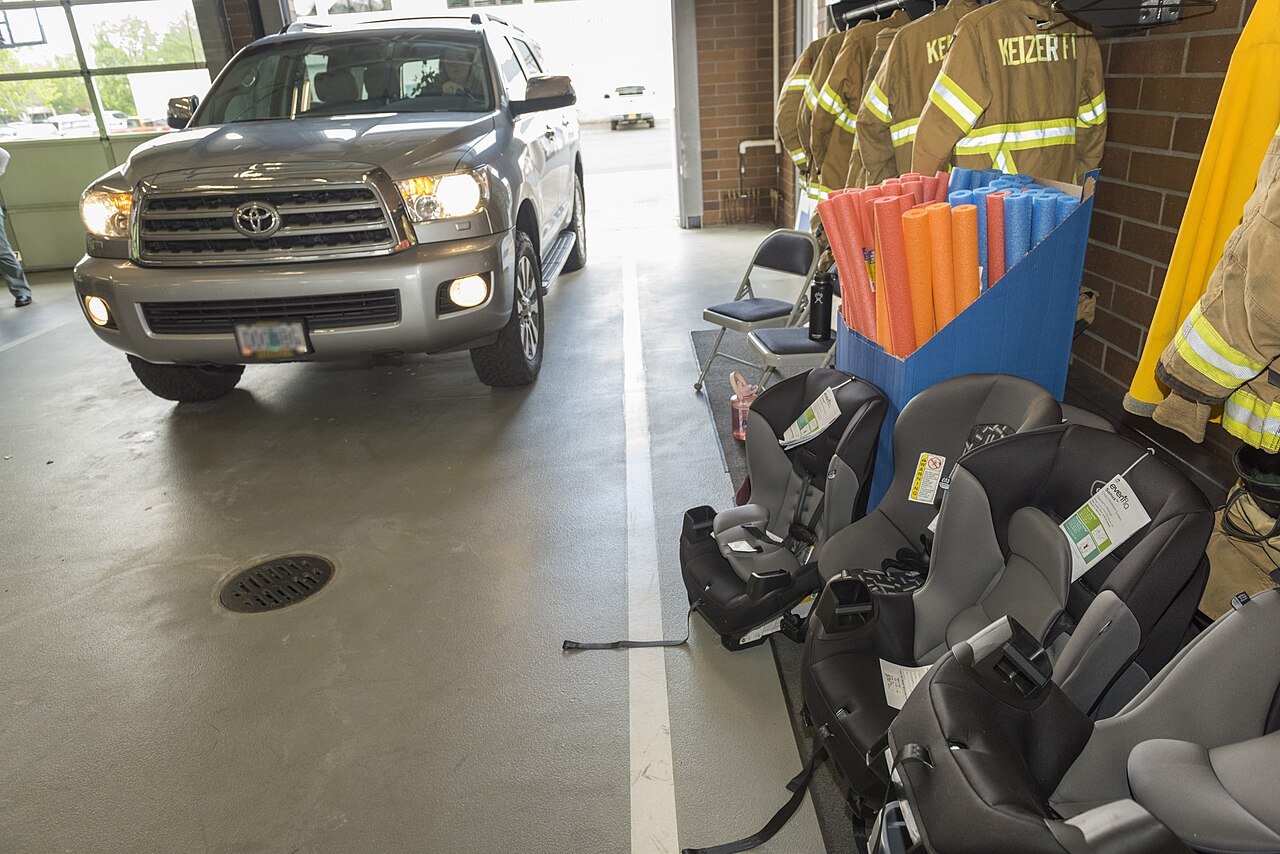
Correct restraint use remains one of the largest single interventions in child road safety, and misuse rates in observational studies are persistently high [2]. A long drive is worth a two-minute check before departure rather than a roadside correction later: harness height relative to the shoulder, chest clip position, and how much slack the harness actually has once the child is dressed for the car.
Winter coats are the common error. A coat compresses under load, so a harness that felt snug over it is loose in a crash. Strap the child without the coat and put it on backwards over the harness, or use a blanket.
Motion sickness on this route
Susceptibility peaks in roughly the six-to-twelve age range, and the provocative conditions are winding roads, rear-facing or low seating positions, and looking down at a screen or book [3]. If any of the route is mountainous, seat the most susceptible child where they can see furthest forward, and treat screens as something to ration rather than assume.
The full evidence review, including what the drug options actually show, is on our <a href="/travel-sickness/">travel sickness page</a>.

Where these numbers come from
The 313 km figure is a straight-line distance between city centres scaled by a routing factor, not a road-network calculation — it is close enough to plan around and will differ from your mapping app by a few percent. Driving time assumes motorway-dominant routing at typical European limits with no significant congestion. Break arithmetic is exactly what is described above: 20 minutes each, at 2-hour or 1.5-hour intervals.
Nothing on this page is a claim about specific service stations, opening hours or facilities on this route. We do not have verified data for that, so we do not print it.
How long does Vienna to Prague really take with children?
Should we split it over two days?
How often should we stop?
Is it better to drive overnight while they sleep?
References
Every citation below links to the original peer-reviewed record on PubMed or via DOI. Nothing here is a substitute for medical advice.
-
Pediatric motor vehicle crashes injuries: A systematic review for forensic evaluation Giovannini E, Santelli S, Pelletti G, et al. · International journal of legal medicine · 2024 · Systematic review DOIPubMed 38337078Full text
-
Scopolamine for patients with motion sickness: a systematic review and meta-analysis with trial sequential analysis Zhang YX, Niu XY, Xiao ZY, et al. · Acta oto-laryngologica · 2024 · Meta-analysis DOIPubMed 39225593
-
Surveillance methods and interventions implemented in American Indian and Alaska Native communities to increase child restraint device and seat belt use in motor vehicles: a systematic review Virtue C, Goffe C, Shiang E, et al. · Injury prevention : journal of the International Society for Child and Adolescent Injury Prevention · 2024 · Systematic review DOIPubMed 38302282Full text
-
Antihistamines for motion sickness Karrim N, Byrne R, Magula N, et al. · The Cochrane database of systematic reviews · 2022 · Systematic review DOIPubMed 36250781Full text
-
[Update on PONV-What is new in prophylaxis and treatment of postoperative nausea and vomiting? : Summary of recent consensus recommendations and Cochrane reviews on prophylaxis and treatment of postoperative nausea and vomiting] Kienbaum P, Schaefer MS, Weibel S, et al. · Der Anaesthesist · 2022 · Meta-analysis DOIPubMed 34596699
-
Saving lives through road safety risk factor interventions: global and national estimates Vecino-Ortiz AI, Nagarajan M, Elaraby S, et al. · Lancet (London, England) · 2022 · Systematic review DOIPubMed 35779550
-
Systematic review of child passenger safety laws and their associations with child restraint system use, injuries and deaths Sartin EB, Lombardi LR, Mirman JH · Injury prevention : journal of the International Society for Child and Adolescent Injury Prevention · 2021 · Systematic review DOIPubMed 34011513
-
Facilitators and barriers to child restraint use in motor vehicles: a qualitative evidence synthesis Bhaumik S, Hunter K, Matzopoulos R, et al. · Injury prevention : journal of the International Society for Child and Adolescent Injury Prevention · 2020 · Systematic review DOIPubMed 32447304